

Adaptation of the general ruling on avian influenza
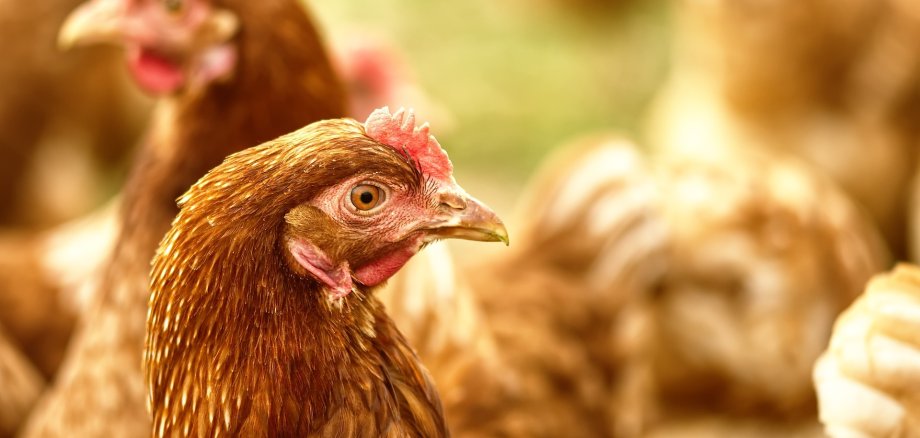
In October, three dead cranes were found at Lake Twist, which tested positive for the bird flu virus at the Friedrich Loeffler Institute. As a result, the district's food monitoring, animal welfare and veterinary services issued a general ruling obliging all poultry farmers to keep their animals indoors to protect them from the highly infectious flu.
Due to the end of the bird migration period and the recent detection of bird flu in resident birds at Lake Edersee, the measures ordered have now been adapted by a new general ruling for the district of Waldeck-Frankenberg. The general ruling applies with immediate effect - for a district-wide obligation to keep poultry on farms with more than 1,000 animals and for farms with more than 50 animals in the risk areas at Lake Edersee. The increased biosecurity measures and the ban on poultry-related events remain in place. The information can be viewed in detail online on the district's website at www.landkreis-waldeck-frankenberg.de/vogelgrippe.
Compulsory stabling for farms
The new general ruling is the district's response to the current infection situation. In the weeks following the first findings in October, migratory birds in particular initially played a significant role in the spread of bird flu. With the end of the bird migration, the risk of infection from these birds recedes into the background. In contrast, an increasing number of sick and dead resident birds such as whooper swans, ducks and Egyptian geese are currently being found - particularly at Lake Edersee and in the lower Eder Valley. In consideration of the new situation, the obligation to keep poultry in the district was therefore relaxed as far as possible. Taking into account the consequences of an outbreak in the domestic poultry population, farms with more than 1,000 animals in the district of Waldeck-Frankenberg must continue to keep their poultry indoors. In the risk areas around the Edersee and lower Edertal, this already affects farms with more than 50 animals. This applies in particular to poultry farmers in the urban and municipal districts of Altwildungen, Wega, Affoldern, Anraff, Bergheim, Bringhausen, Buhlen, Giflitz, Hemfurth-Edersee, Mehlen (with Lieschensruh), Wellen, Asel, Basdorf, Buchenberg, Harbshausen, Herzhausen, Kirchlotheim, Marienhagen, Schmittlotheim, Vöhl, Waldeck town centre and Nieder- and Ober-Werbe. This means that, as a precautionary measure, these farms are still only allowed to keep their animals in closed stables or covered aviaries rather than on pasture.
Contact with wild birds
It is still important that direct or indirect contact between poultry and wild animals or their faeces is avoided as far as possible. Sick birds excrete the pathogen in their faeces and with mucus or fluids from their beaks and eyes. In the event of direct contact, other animals become infected by inhaling or picking up material containing the virus. Transmission can also occur through contaminated utensils such as vehicles, equipment or packaging material.
Increased biosecurity measures and ban on events
The increased biosecurity measures and the ban on events in the original order continue to apply. In addition, if a sick or dead wild bird, especially waterfowl such as swans, ducks, geese, herons or cranes, but also birds of prey, is found, the veterinary office of the Waldeck-Frankenberg district should be informed by calling 05631 954-1753. In this context, the district once again draws attention to the fact that all poultry farms in Waldeck-Frankenberg, including smaller and non-commercial ones, must be registered with the district - regardless of how many animals they have. They must also be registered with the Hessian Animal Disease Fund.