Exchange with WIBank: District wants to obtain funding for projects
As part of the joint task "Improvement of the regional economic structure", or GRW funding for short, the federal and state governments provide funds to support projects that strengthen the regional economy. The district, its economic development agency and a number of local authorities and companies want to obtain funding for three projects in Waldeck-Frankenberg - and have discussed this locally with District President Mark Weinmeister and representatives of the Wirtschafts- und Infrastrukturbank Hessen, or WIBank for short, which is handling the process in Hesse.
Shaping the economy, activating potential, reducing land consumption
The programme was modernised on 1 January. "Access to regional funding has been simplified since this year. The new version makes procedures for reactivating industrial and commercial sites much easier," explains the district's economic development officer Dimitrij Schmalz. In future, there will be a greater focus on projects in the fields of digitalisation, sustainability, tourism infrastructure, regional value creation and the development of industrial and commercial sites.
"The reform aims to make the regional economic structure more sustainable and promote equal living conditions - especially in rural regions with a lot of potential," says District Administrator Jürgen van der Horst. "Three projects in the district, which we are currently discussing with WIBank representatives, also fit in with this." The representatives learnt about the various projects in Bad Arolsen, Mengerinhausen and Berndorf on site.
Development of a residential neighbourhood on the Lahrmann site in Bad Arolsen
The aim of the town of Bad Arolsen is to develop a high-quality residential neighbourhood on the site of the former Lahrmann site, in which current requirements for sustainable building materials, regenerative energy use and measures for climate protection and adaptation are taken into account. "Sustainable and attractive living space in an appealing environment is an important big point in attracting skilled workers and directly serves to strengthen the local economic structure," emphasises Marko Lambion, Mayor of Bad Arolsen. "The ideally located Lahrmann site fulfils all the requirements if we succeed in developing the site into a future-oriented residential quarter in a targeted, structured and, above all, economical way."
Recycling of mineral construction waste in Mengeringhausen
Wenowa Baustoffe would also like to establish an energy self-sufficient, fully electric and digitally controlled recycling centre in Meneringhausen for the acceptance, processing and recycling of mineral construction waste - including a photovoltaic system, battery storage, charging infrastructure, fully electrified machinery and digital control systems. The aim is to promote a sustainable circular economy with CO₂ reduction, regional value creation and long-term profitability and competitiveness. "In the centre of Nordwaldeck, our energy self-sufficient recycling centre is setting a new benchmark for the recycling of mineral construction waste," says Managing Director Jörg Marpe. "Thanks to modern electrical technologies, digital intelligence and a genuine circular economy, we are creating a pioneering system, ecological added value and driving forward the path to a low-carbon future. In doing so, we are not only strengthening the environment, but also the economic sustainability of our region."
Conversion of the former Wilke site in Berndorf
The municipality of Twistetal would like to revitalise the "Stukenhof site" in Berndorf, the site of the former Wilke company - including the dismantling of the contaminated buildings and subsequent reuse. The demolition was divided into two construction phases: The first has already been implemented and comprised building pollutant remediation, mechanical demolition and additional concrete remediation. The second construction phase is currently being planned. The utilisation of the renovated main building as a shell for future use is also being examined. "The Stukenhof site is both a task and an opportunity," says the mayor of the municipality of Twistetal, Friedrich Vogel. "A future-orientated development, including the construction of a new school for Twistetal primary school, is the declared aim of the municipality."
The extent to which the projects presented fulfil the eligibility criteria for GRW funding is assessed by WIBank, which handles the application process in Hesse and decides on the non-repayable investment grants for partial financing within the framework of the guidelines. In 2026, a total of around 1.3 billion euros will be available for the GRW throughout Germany. The funding will be split equally between the federal and state governments. "The measures are highly interesting and very creative," says WIBank management spokesman Gottfried Milde. "We are very happy to look at all funding opportunities and are of course also examining possible GRW funding."
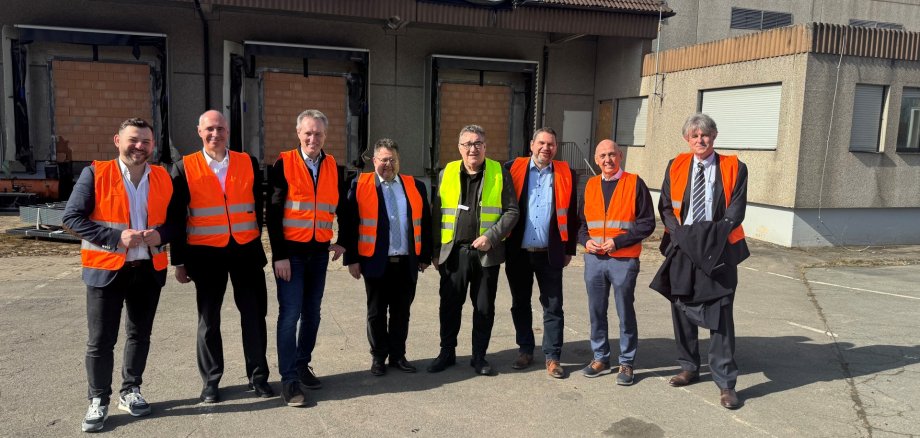
Caption: Looking at possible funding projects together: The district's business development officer Dimitrij Schmalz, Marcus Runge from WIBank, District Administrator Jürgen van der Horst, Twistetal Mayor Friedrich Vogel, District President Mark Weinmeister, Bad Arolsen Mayor Marko Lambion and Gottfried Milde and Matthias Wulff from WIBank. (Photo: District of Waldeck-Frankenberg)