Health conference sends a strong signal for children's health
The first municipal health conference in the district of Waldeck-Frankenberg took place yesterday under the motto "Child health - networking stakeholders - expanding opportunities - shaping the future". Numerous specialists, institutions and decision-makers from the health, education and social sectors came together to jointly develop ways for children to grow up healthily in the region.
Kick-off with a clear message: strengthening health from the start of life
The Municipal Health Conference is a central coordination body. Together with representatives from the various areas, the aim is to recognise problems on site and develop possible solutions. First District Councillor and Head of Health Karl-Friedrich Frese opened the event and emphasised the importance of the early years of life for a child's overall development. "Children are our future. Their health not only influences their well-being today, but also their opportunities tomorrow - at school, at work and in society," explained Frese. "That's why it's our common goal to establish permanent structures, networks and decision-making channels so that health promotion doesn't happen by chance, but is plannable, coordinated and impact-orientated. Today, we are laying the foundations for a shared future for the health of our children and their families." In autumn 2022, the district council established the health conference at the suggestion of the district committee with the aim of creating a permanent forum for exchange, networking and joint approaches to health-related solutions.
Impulses from science and practice
The conference participants gained a wide range of insights into current developments and challenges in child health. The keynote speech by Dr Katharina Böhm, Managing Director of the Hessian Working Group for Health Promotion, was dedicated to the "Health in All Policies" approach - the idea of considering health as a cross-sectional task in all municipal fields of action. Other practical topics were also presented, including the results of school enrolment examinations in the district, a new digital map for prevention services and initiatives to promote breastfeeding in the district of Waldeck-Frankenberg. These impulses formed the basis for in-depth discussions and workshops in the further course of the conference.
Networking is key: taking responsibility together
From daycare centres and schools to medical professionals, politicians, administration and health insurance companies: One of the main aims of the event was to get the various stakeholders talking to each other. "Our district has strong potential: committed players and teams in the offices, in the living environments, in the associations, in healthcare and, of course, many active citizens. Together, we can create structures that meet children where they are - where they live, learn and play," emphasises Frese. The aim is to create sustainable, health-promoting structures and living environments throughout the district through a joint, coordinated approach by all stakeholders. The coordination centre in the health department plays a central role here in order to bundle activities, avoid duplicate structures and harness synergies.
A look at children's living environments
Central topics of children's health were highlighted in various discussion rounds - from exercise and nutrition to mental health and the importance of family, daycare centres and schools. Frese called on the participants to make active use of the day: "I invite you to share perspectives, learn from each other and jointly develop sustainable approaches for our region. Instead of asking: 'How do we treat illness?' today we want to ask: 'How do we create health?"
Results of the workshops, conclusion and outlook
The participants of the health conference were able to record the various opportunities and challenges for children on four display boards. "The results of the workshop will be analysed in the next step. However, during the various discussions and questions after the specialist presentations, it became clear that the transition between daycare centre and school is an issue that requires particular attention," explains Julia Brand from the health department. Karl-Friedrich Frese went on to say that the next steps would be to use the information gathered to identify the needs and create a needs-based service structure in a next workshop together with the employees of the district administration who work with children. "The health conference showed very clearly that the participants are very interested in networking and advancing the topic of children's health. The active participation made this very clear," concludes Brand. In future, the health conference will take place for different age groups and serve as a driving force for a networked, prevention-orientated health strategy in the district.
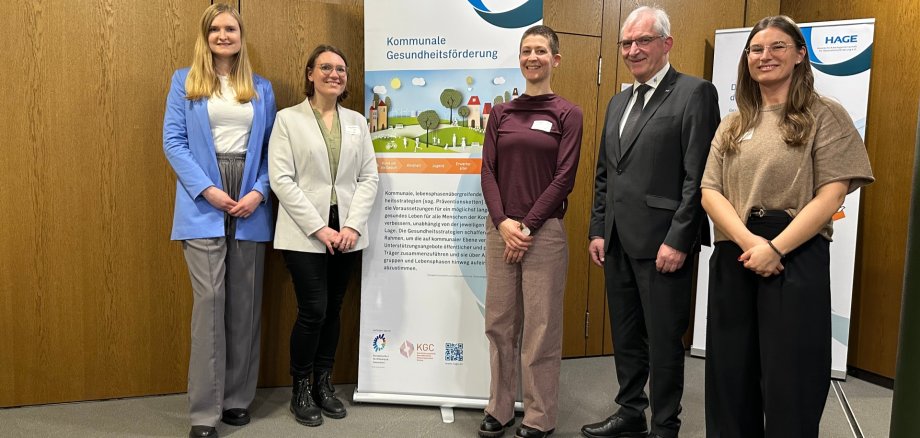
Caption: From left: Julia Brand from the Health Department, Jacqueline Stärklow, Hessian Ministry for Family Affairs, Senior Citizens, Sport, Health and Care, Dr Katharina Böhm, Managing Director of the Hessian Working Group for Health Promotion, First District Councillor Karl-Friedrich Frese and Katharina Wilke from the Health Department are looking forward to the joint exchange at the health conference. Photo: District of Waldeck-Frankenberg
Background information:
The Municipal Health Conference is a central coordination body and is intended to be used as a communication and coordination platform. The aim of the conference is to recognise local problems and jointly develop possible solutions. To this end, representatives of all organisations and areas involved in promoting, maintaining and restoring health at a local level come together.
At a local level, the health conference helps to define local objectives for health promotion, prevention, medical care and nursing care and to support a regionally needs-based distribution and organisation of care structures. The health conference deals with the topics of healthcare, health promotion and prevention in a citizen-centred manner, adapted to local conditions and with the involvement of all relevant local stakeholders and interest groups, and identifies deficits and areas where action is needed.