

Practical environmental education - District Administrator visits Berndorf primary school
In February, more maintenance work was carried out on hedges and shrubs, as this pruning was only legally permitted until the end of the month for nature and species protection reasons. Maintenance work was also carried out in the outdoor areas of Berndorf Primary School around the schoolyard. The maintenance work was not agreed with the school management and two trees that had been planted by the schoolchildren as part of a project were accidentally removed during the work.
The "Ideen-AG Mitbestimmung und Demokratie" (participation and democracy ideas group) of the school's 3rd and 4th classes took the sight of the cut down bushes as an opportunity to write a letter to District Administrator Jürgen van der Horst. The girls and boys wanted to know the reason for the "deforestation" and whether there was no way they could have been consulted beforehand. This initiative impressed the district administrator so much that he approached the "Ideen-AG" in Berndorf to personally contribute to environmental education using this practical example. Together with expert Jessika Sachse from the Environment and Climate Protection Department, he was able to explain the connections to the satisfaction of the young letter writers.
Why are the bushes pruned so heavily that it looks like a desolate forest when so many trees died because of the drought? Do the bushes grow as thick and tall as they did before the pruning? And why can the district commission such maintenance work at all? These were just some of the questions that the schoolchildren put to the district administrator and his staff.
"We are the school authorities, so we are responsible for the school buildings in Waldeck-Frankenberg and this responsibility also includes pruning," explained van der Horst. Nevertheless, the district should have informed the school management about this, which was unfortunately neglected. It was also regrettable that the young trees, which the staff mistook for bushes, were removed by mistake. "Sometimes you have to apologise if things haven't gone well," van der Horst immediately put into practice.
The district administrator went on to explain the work: Regular maintenance, the so-called "planting up", helps nature and animals. The result is denser shrubs that offer better hiding places for birds and insects and provide more food for bees and butterflies. The result is a more lively environment - typical for ornamental shrubs, which dominate 80 per cent of the schoolyard.
"The buds come back, the branches become stronger and more stable, and overall the ornamental shrubs live longer than if they were not regularly cared for," confirmed Jessika Sachse, who is not only professionally but also privately active in nature conservation as a member of NABU. In contrast, it is important to bear in mind that trees will also suffer losses in the root system if the crown is damaged. "Free-growing native hedges are of course also important," added Sachse - but more in open fields, not indoors, where road safety and building maintenance play an overriding role.
From a nature conservation point of view, the fact that pruning is carried out in spring, when the first buds are already visible, is rather acceptable. This is because, according to experts, animals that use hedges and shrubs as a habitat are least disturbed from October to February. Taking nature conservation and environmental protection into account, the legislator has therefore established the rule that no maintenance work may be carried out from 1 March to 30 September in order to protect the habitat of the animals.
At the end of the visit, the members of the working group addressed requests to the district administrator, e.g. "I would like the school to be informed next time" or "I would like us to be asked beforehand, you could also do a survey for the children." Van der Horst praised: "I think it's great how intensively you dealt with the topic in the working group and questioned something that didn't seem right to you. This not only shows how much you care about the topic, but also that you want to help find a solution yourselves." Democracy is very important and adults can definitely learn from children in this respect. The youth parliament, which is currently being set up in the district, picks up on this idea.
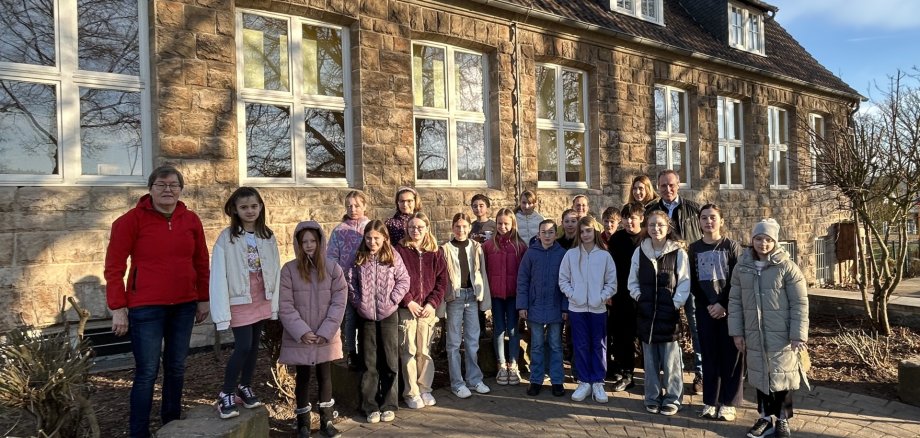
Caption: District Administrator Jürgen van der Horst (back row, right) and his colleague in the Environmental and Climate Protection Department Jessika Sachse (back row, 3rd from right) explain the background to pruning ornamental shrubs - members of the Berndorf primary school's ideas working group on co-determination and democracy with their teacher Susanne Koswig (front row, left). Also in the picture: Janina Winkler, Environmental and Climate Protection Department (to the left of District Administrator van der Horst). Photo: District of Waldeck-Frankenberg