District takes part in Arolsen Archives' crowdsourcing initiative
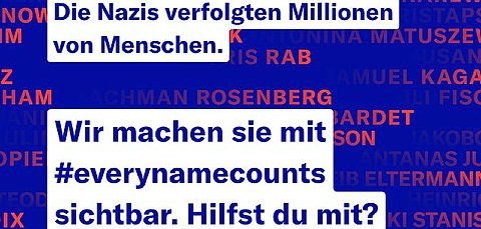
Millions of people were persecuted and murdered during the Nazi era. In order to preserve the memory of each individual fate, the district of Waldeck-Frankenberg is taking part in the international crowdsourcing initiative #everynamecounts organised by the Arolsen Archives, the world's largest archive for victims and survivors of National Socialism. During the campaign period from 8 to 23 May, the district is calling on all citizens to take part in the initiative.
Digitise documents from the Nazi era
How does it work? Original documents from the period of Nazi persecution can be digitised online. These will later be included in the online archive of the Arolsen Archives. To do this, they must be labelled with data so that they can be found in a search. So far, this work can only be done to a limited extent by programmes, as the manuscripts are often difficult to read or partly in Sütterlin. This is why real people are asked to look at the documents and transfer certain details - from name and date of birth to address. The simplest documents can be digitised in under five minutes.
Introductory event on 12 May
If you would like to find out more about exactly how the digitisation of documents works, you can take part in a digital introductory event at the Arolsen Archives on 12 May at 6:30 pm. Registration is possible online or by e-mail. The participatory campaign will run until 23 May, Democracy Day. Then we will see how many documents in total have been digitised via the shared link by people from Waldeck-Frankenberg.
Digital memorial for victims of National Socialism
The aim of the campaign is to collect personal data from hundreds of thousands of historical documents and thus create a digital memorial to the victims of National Socialism - including those from Waldeck-Frankenberg. Hundreds of people were also deported from the district to the Nazi concentration and extermination camps between 1933 and 1945, around 50 of whom were imprisoned in Buchenwald. Their fates should also be remembered - for example that of Friedrich Wagener from Külte, a so-called Bible scholar (Jehovah's Witness) who refused to do military service and was interned in various concentration camps before being liberated from Buchenwald concentration camp. Or that of Bernhard Löwenstein from Korbach, a victim of euthanasia who was gassed to death in a killing centre in Brandenburg at the age of 25.
A sign of humanity, democracy and freedom
"With this campaign, we want to send a signal in turbulent times that we stand together as a district: For humanity, for democracy, freedom and peace. To ensure that our children and grandchildren do not become names on any lists," says District Administrator Jürgen van der Horst. "An honest look at the past has nothing to do with personal guilt or making us feel bad. It's about learning from what has already happened, appreciating what we have and taking a clear stance."
Keywords:
Preventing extremism Specialist service for rural areas Events