

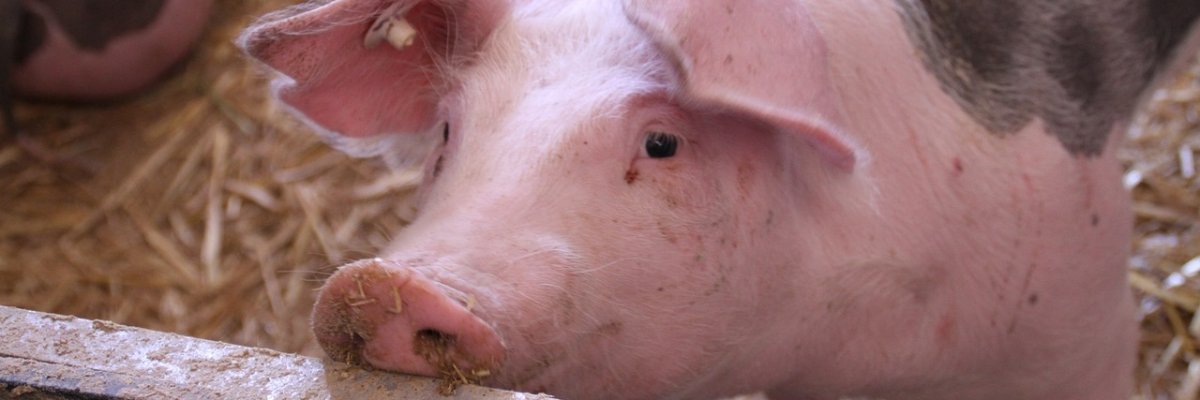
Agriculture and pig farming
Agriculture & pig farming
Pig farmers should prepare for ASF by taking appropriate precautions to prevent the virus from entering their herds. It is important that all animals - including hobby farms - are registered as such with the district authorities. In addition, appropriate biosecurity measures should be implemented as a precautionary measure.
Implementation of measures to protect against biological hazards (biosafety)
- Preparation of a biosecurity action plan (plan for protection against biological hazards)
- Mandatory for all pig farms, regardless of farm size
- Approval of this plan by the veterinary office
Regular official veterinary farm visits with clinical examination
- At least twice a year
- In restricted zones I and II: at intervals of at least four months
- In restricted zone III: at least every three months
Permanent monitoring programme for the detection of the ASF pathogen
- As a rule: PCR analysis of blood samples from the first two pigs to die each week
Pig farmers are therefore strongly advised to prepare now and draw up a biosecurity action plan for their farm - and submit it to the district of Waldeck-Frankenberg. A helpful template from the North Rhine-Westphalia Chamber of Agriculture can be found here. Pig farmers should seek advice from their farm veterinary practice, the pig health service of the Hessian State Laboratory or the Hessian State Agricultural Organisation.
FAQs - Frequently asked questions for agriculture & pig farming:
The most important questions and answers relating to ASF for pig farmers and farmers are summarised here:
Agriculture
How should game damage in the exclusion zones be dealt with?
As hunting is currently possible in both restricted zones and increased hunting is even expressly ordered in restricted zone I, game damage must continue to be compensated in accordance with the relevant provisions of the BJagdG.
Can machines that were used in exclusion zone II be used outside the zone?
According to the current general regulations, the use of machines outside the restricted zone is permitted. However, before transporting or using machines outside the restricted zone, they should be checked and cleaned if necessary.
What processing or harvesting restrictions are there in the restricted zones?
There are no restrictions on processing or harvesting in Restricted Zone I.
Before tillage, mowing or harvesting measures in exclusion zone II, it must be ensured that there are no live or dead wild boar on the area. Above certain growth heights, the area must therefore be searched the same day before using a drone. For grassland and areas with oilseeds, cereals, mixtures, protein plants and legumes, this is the case from a growth height of 60 cm, and for maize from a growth height of 1.5 metres. Special crops such as strawberries and potatoes, which allow a clear view of the ground, do not have to be searched.
When harvesting maize, a cutting height of 30 cm must be maintained.
When do I have to have my areas flown over by drones before harvesting or processing?
Grassland and areas with oilseeds, cereals, mixtures as well as protein plants and legumes must be scanned for live or dead wild boar using a drone from a growth height of 60 cm and areas with maize from a growth height of 1.5 metres. This must be done on the same day under suitable weather conditions before the start of cultivation or harvesting activities. It is recommended that the drone has thermal imaging technology of at least 640 x 512 pixels. The drone operator must then create a flight log. This must be kept and presented to the veterinary office on request. No additional authorisation or approval is required.
If wild boar are discovered in the area during the drone search, it may not be cultivated, harvested or mowed. A new date must be set for the drone search and the cultivation, harvesting or mowing.
During hay harvesting, no further drone search is required for the activities following mowing (turning, baling).
Can I spread pig slurry and manure?
As long as there is no ASF outbreak in a domestic pig herd in restricted zone II, slurry/pig manure can be spread within restricted zone II. It is not possible to spread this slurry outside this zone. There are no restrictions for restricted zone I.
Am I allowed to feed crops from restricted zone II?
There are no restrictions or requirements for feeding to animals other than pigs. Harvested crops that cannot be used in pig farming or come into contact with wild boar can also be sold directly.
When feeding pigs, it depends on the crop and its use. The EU guidelines stipulate that grain should be stored safely for 30 days before being fed to pigs. Alternatively, heating to 70°C for at least 30 minutes is also possible. After these measures, the grain can be sold or fed. Straw, grass and hay must be stored for at least 6 months to protect them from pigs or heated to 70°C for at least 30 minutes. After this time, straw, grass and hay can be safely sold or fed. Harvested material that cannot be used in pig farming or come into contact with wild boar can be used directly.
Are animal species other than pigs affected by restrictions?
No. Other animal species such as cattle, sheep, goats etc. may be moved within or out of the restricted zones without restrictions (e.g. transport, grazing, sale, slaughter).
Is it permitted to carry out forestry activities in the restricted zones?
Forestry activities are permitted in the entire restricted zone I and in restricted zone II outside the core zone. Attention must be paid to wild boar carcasses and any finds must be reported immediately to the veterinary office.
Pig farming
What preventive measures are in place to prevent the introduction of ASF?
The only protection for domestic pig herds is consistent compliance with biosecurity on farms. The primary aim is to prevent contact between domestic pigs and wild boar. The farmer must seal off his herd in such a way that any contact with wild boar is made impossible.
The feeding of food waste is prohibited! The legal basis for this is the Pig Husbandry Hygiene Ordinance (SchHaltHygV). This contains the biosecurity measures to be complied with even in epidemic-free periods for all farms that keep pigs for fattening or breeding purposes. In order to protect pig herds, hobby or small-scale farmers are also required to implement the necessary measures in accordance with the Pig Husbandry Hygiene Ordinance. This is because, on the one hand, the disease is usually fatal and, on the other hand, hobby pigs are also affected by the measures in accordance with the relevant EU regulations (in the worst case, the animals are killed). The hygiene and biosecurity measures include
- Lock the barn! Prevent wild boars from coming into contact with domestic pigs.
- Store bedding and feed in a way that is safe for wild boar.
- Do not feed kitchen and food waste with animal parts.
- Do not feed green fodder - it could be contaminated by wild boar.
- The barn should only be entered by the owner and a person authorised to care for the animal and unavoidable persons (e.g. vet).
- Change shoes when entering and leaving the stable. A complete change of clothes is best.
- Control rodents and pests.
- Regular cleaning and disinfection of the barn, equipment and vehicles.
- In the event of symptoms such as unwillingness to eat, high fever or sudden deaths in the pig herd, call the vet directly.
- Always dispose of dead animals via the rendering plant and store them out of reach until collection.
The BMEL brochure "Protection against animal diseases - what farmers can do" with information on implementing the measures of the SchHaltHygV and the risk traffic light of the University of Vechta can be used to check your own herd.
What do pig farmers in restricted zone I have to consider?
In restricted zone I, pig farmers must, among other things, immediately
- to make certain notifications and reports to the competent veterinary office
- to prevent contact between pigs and wild boar
- to have dead or sick pigs suspected of having ASF examined
- Keep feed, bedding and other materials inaccessible to wild boar
- set up functional disinfection facilities
- Use protective clothing
- to keep daily records of visitors
The transfer of pigs within Germany (for slaughter or to other farms) is still possible without authorisation.
What do pig farmers in restricted zone II have to consider?
For pig farmers, the following applies in addition to the requirements for restricted zone I:
- A movement ban or a reservation of authorisation for pigs
- Movement restrictions for products, products and germ cells
- A confinement order for kept pigs
Can I deliver pigs from the restricted zones for slaughter or other reasons (sale of piglets, etc.)?
Pigs from restricted zone I can be sold within Germany without restrictions. A movement ban applies to restricted zone II. Delivery for slaughter etc. is only possible under strict conditions and with authorisation from the veterinary authorities.
What should a pig farmer do if he suspects a case of African swine fever?
Pig farmers should immediately contact the county's food control, animal welfare and veterinary service, take quarantine measures and not transport pigs, products or materials from the farm or transport or sell materials from the farm until an official diagnosis has been confirmed.
How does the disease control work in the event of an outbreak?
In the event of an outbreak, environmental zones are established around the affected farm, strict biosecurity measures are enforced, infected and potentially infected animals are culled and the affected areas are disinfected to prevent further spread.
What financial aid is available for the affected pig farmers?
In the event of an outbreak of ASF in domestic pigs, affected farms receive half of the compensation payments from the animal disease fund and half from the state of Hesse. The amount of compensation is based on the fair market value of the animals to be killed and those that have died; the corresponding maximum rates are set by law. In addition, in certain cases, subsidies for cleaning and disinfection are granted as voluntary benefits by the Animal Disease Fund.
When are pig farmers entitled to compensation?
The principles of compensation are regulated in the Animal Health Act. Among other things, farmers whose animals were killed by order of the authorities or died after being ordered to be killed can apply for compensation. In addition, pursuant to Section 6 of the Animal Health Act
- the owner or holder of a property that is affected by barrier measures,
- the owner or holder of agricultural or forestry land,
- whose use has been prohibited or restricted,
- who has been obliged to create hunting lanes,
demand compensation in accordance with the respective state regulations on the utilisation as a non-disturber (farmer without a pig farm or a field without a direct connection to a pig farm). In Hesse, compensation is based on the Hessian Law on Public Safety and Order (HSOG). Accordingly, compensation is generally only granted for financial loss.