The state is funding the ‘Inclusive Early Intervention’ pilot scheme
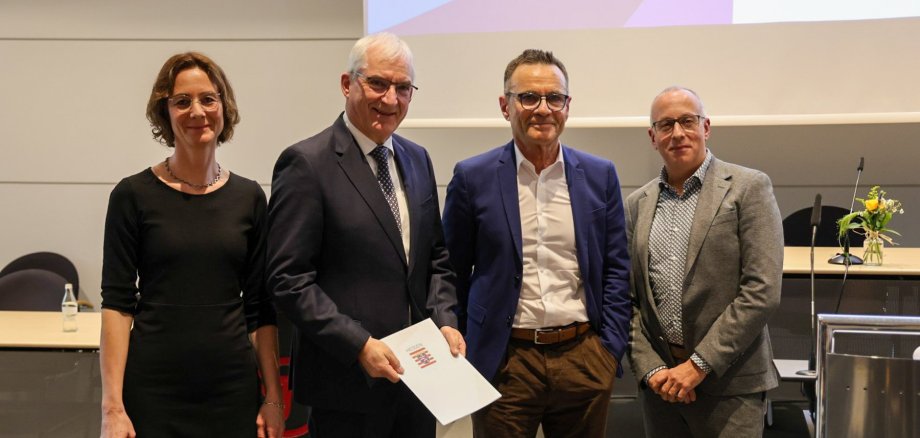
Caption: (from left) Working together for the youngest: Dorike Hentrich from the board of Lebenshilfe-Werk, First District Councillor Karl-Friedrich Frese, Winfried Kron, Head of the Unit for the UN Convention on the Rights of Persons with Disabilities and the Disability Equality Act, and Christoph Hille, also from the board of Lebenshilfe-Werk. Photo: Lebenshilfe-Werk Kreis Waldeck-Frankenberg e. V.
The Waldeck-Frankenberg district is a model region for ‘inclusive early intervention’. The project was officially launched at the kick-off event held at the district administration building in Korbach. There, Winfried Kron from the Hessian Ministry of Labour, Integration, Youth and Social Affairs presented the funding approval for 300,000 euros to the First Deputy District Administrator, Karl-Friedrich Frese. The aim of the project is to sustainably expand and further develop preventive and inclusive support for children and their families in the district. To implement this, the district administration is working closely with Lebenshilfe-Werk Kreis Waldeck-Frankenberg e. V. The district is channelling the state funding and is also supporting the inclusive early intervention project with around 170,000 euros. Further third-party funding is currently being planned. A total of around 490,000 euros is thus earmarked for the ‘Inclusive Early Intervention’ pilot region.
Right from the start: promoting development, enabling participation
The pilot project focuses on the aim of identifying risks to children’s development at an early stage, providing comprehensive support and strengthening families, and ensuring rapid access to support services. The service is explicitly aimed at all families who need support.
The concept of inclusive early intervention is understood as a holistic and family-centred support system for children from birth until they start school. It combines educational, medical-therapeutic and socio-educational expertise and is tailored to the individual needs of the children and their families. This includes, amongst other things, free early intervention advice with no application required, interdisciplinary assessment, mobile and outpatient support, as well as preventative services in family centres and childcare centres. Winfried Kron, Head of the Unit for the UN Convention on the Rights of Persons with Disabilities and the Disability Equality Act, explained: “Every child deserves the chance to develop well and participate on an equal footing. By promoting inclusive early intervention, we are supporting families right from the start and creating better conditions for education, health and social participation.”
Better coordination, rapid support
A particular focus is on removing barriers to access. Families should receive support without long waiting times and without complicated application procedures. To this end, paediatricians’ practices, nurseries, schools, the health service and youth welfare services are being more closely linked so that support can be provided from a single point of contact. Local services are being set up in Frankenberg, Bad Wildungen, Korbach and Bad Arolsen. “Families need quick and unbureaucratic support, particularly in challenging situations. With our inclusive early intervention programme, we aim to significantly expand preventative services, make access easier and better link existing services together,” says Dorike Hentrich from the board of Lebenshilfe-Werk.
State, district and Lebenshilfe-Werk join forces
To implement the project, the Hessian Ministry of Labour, Integration, Youth and Social Affairs, the district of Waldeck-Frankenberg and Lebenshilfe-Werk Kreis Waldeck-Frankenberg e. V. are working togetheras partners. The concept was developed by Prof. Dr Armin Sohns, one of the most renowned experts in the field of early intervention. He will provide expert guidance throughout the implementation. “Together, we can make a real difference,” explained First District Councillor Karl-Friedrich Frese. “We want to further improve life in the Waldeck-Frankenberg district for our youngest residents. But not just here in the district. As a model region, we will make the results available to other districts in Hesse so that our entire federal state can benefit from them.”
Kick-off event marks the start of the project phase
The kick-off event on Wednesday began at 10 am at the district administration building in Korbach. Following the welcome and opening remarks, Prof. Dr Armin Sohns gave a presentation on ‘Inclusive Early Intervention’. This was followed by a panel discussion, before the event drew to a close with light refreshments. The pilot project will now run until at least 14 August 2028. During this period, all services will be systematically documented and evaluated. The findings will be used to produce a practical guide to help other districts adopt the concept. The results could thus provide impetus for early intervention across the whole of Hesse.