

Museum in the monastery
Museum in the monastery
The Frankenberg Museum was founded in 1952 as a district museum in the north wing of the Cistercian convent of St Georgenberg, which was dissolved during the Reformation. This 13th century building, which has housed various offices since the end of the 16th century, is still home to the museum today. Following the comprehensive redesign, you will find an exhibition on the town and district of Frankenberg in the former cloister, the refectory, the dormitory and the Romanesque Mauritius Chapel. It takes you from the great heyday of humanism to the time of the district town in the 19th and 20th centuries. Get to know people and their times!
Philipp Soldan and Tyle von Frankenberg
Frankenberg has borne the additional designation "Philipp Soldan City" since 2018. This is dedicated to one of its most outstanding sons. Soldan, who was born around 1500, worked in Frankenberg and the region as a stone sculptor, wood carver, mould maker, painter and master builder. He left behind important works that still fascinate today with their artistic charisma. As for Tyle von Frankenberg, who worked in the town several generations before Soldan, the Church of Our Lady also became a temporary centre of his work during the period of humanism and the Reformation from the 14th to the 16th century. The museum in Frankenberg Monastery preserves numerous works by both artists, reminding us of the town's early heyday.
Views of the city and circles
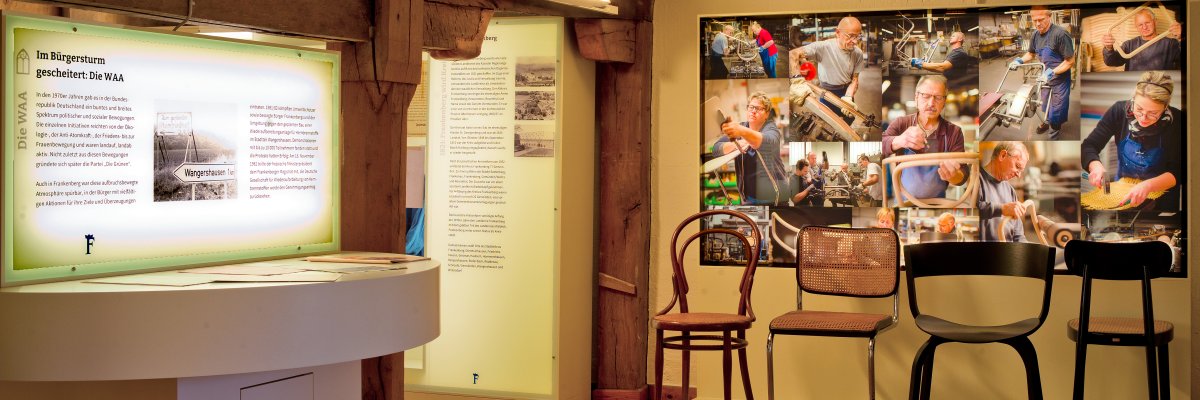
The City Views and District Views section displays interesting, unusual and rare exhibits from the museum's diverse collection on the following topics: 1821: Frankenberg becomes a district - 1821: The centre of the district - Frankenberg's backbone: cloth and leather - The Niedermühle: water art and power generation - About living together in the Shoah - The fate of Frankenberg resident Jacob Katzenstein (1865-1943) - Times of hardship and National Socialism - The fate of Frankenberg resident Karl Richter (1907-1944) - Club involvement: Of cyclists, role models and the march into the Listenbach - Mining: Frankenberg, Geismar, Thalitter - Traditional costumes in the district - Fashionable hats in the town - Hessenstein Castle - Keseburg ruins - 1933/45 - 1968 - The doctor August Loderhose and "the 68ers" - The German small-town man - Failed in the middle classes: the WAA On passing on the memory
Cistercian Monastery St. Georgenberg
The historic Cistercian convent of St. Georgenberg in Frankenberg now houses one of the administrative offices of the Waldeck-Frankenberg district. The historic building in the middle of the Philipp Soldan town of Frankenberg also houses the historic "Museum im Kloster" of the Waldeck-Frankenberg district in the north wing.
History
The foundation of the former Cistercian convent goes back to a foundation by the noble lords of Itter, who owned a domain north of Frankenberg. Their attempt to found a convent near Sachsenberg failed. With the help of the landgraves of Thuringia, the new monastery was then built at the gates of Frankenberg from 1249 and endowed with the patronage of the Frankenberg chapel.
The castle and town of Frankenberg were intended to serve as a base for the Hessian-Thuringian landgraviate and the monastery of St. Georgenberg was to help strengthen their influence in this area. This rather secular intention and the fairly close proximity to the up-and-coming town of Frankenberg meant that the monastery played a weighty role not only in the religious sphere but also in the social life of the region.Religious and lay sisters
Its residents were divided into nuns of the religious order and lay sisters, the former largely hailing from families of the landed gentry and the patrician families of the surrounding towns, whilst the lay sisters also came from lower social classes. These close family ties between the surrounding countryside, the nearby town and the convent’s residents led to lively interactions that extended St Georgenberg’s influence beyond the convent walls. The convent was dissolved in 1568, but the nuns – the last of whom died in 1581 – were still permitted to remain there.
Architecture
The two-storey, three-winged building group from the 13th to 17th centuries is well preserved and still appears as a whole today. The side open to the east has been largely closed by a modern building that houses the administrative office of the district administration with the state district office. As a result, the monastery complex is difficult to recognise from the city. The interiors have been redesigned to suit the respective purpose.
The most impressive is undoubtedly the north wing, on the east side of which is the late Romanesque former chapel of St Maurice. It is divided by intermediate ceilings. The long narrow round-arched windows date from the middle of the 13th century and give the building its special style. The rest of the north wing was built at the end of the 14th century and modified at the beginning of the 16th century. The part in which the remains of the former cloister with late Gothic tracery windows are located is remarkable.
Museum in the monastery
The "Museum im Kloster" is housed in the north wing of the former monastery. At the centre of the museum exhibits are the works of the Frankenberg artist Philipp Soldan (1500 - 1570), woodcarver, stone sculptor and master of the stove plate in the 16th century. His artistically carved beam heads, which once adorned the Liebfrauenkirche in Frankenberg, can now be found in the museum's cloister. The motifs, which show monks, owls, lions, rams' heads, virgins and masks, among other things, are very impressive and mark the transition from late Gothic to Renaissance in terms of art history. The cloister also houses works by another famous son of Frankenberg: the master builder and stone sculptor Tyle von Frankenberg (14th century). Visitors will find sandstone figures by the artist in the cloister, also from the Liebfrauenkirche, which were removed and partially mutilated (destroyed) during the iconoclasm in 1606 on the orders of the Hessian landgrave Moritz the Learned.
The extensive folklore collection contains special gems of local culture; to name but a few - the oldest blue print in Hesse, a hackle rifle with muzzle-loader from around 1400, representing the beginning of a new generation of weapons, a life-size wooden Baroque figure depicting King David with a harp, a Brützel altar from 1680, a late Gothic sacristy cupboard, the most extensive collection of stülpchen in Hesse and the war chest of a Jewish cattle trader, ca. 1700. In the dormitory, visitors will find display cases with fossils, e.g. Frankenberg corn ears, and finds from early and prehistoric times from the region.