

The district council and the business development agency are driving forward broadband expansion
The district authority and the business development agency intend to work together to drive forward the roll-out of broadband in Waldeck-Frankenberg. The aim is to accelerate the roll-out of gigabit-capable fibre-optic connections for all local authorities in the district, whilst ensuring high standards. To this end, the aim is also to secure federal funding, where possible, under the Gigabit Funding 2.0 scheme.
A fast network is essential for
as a business location“Fast internet is a fundamental prerequisite for economic growth, attractive places to live and a modern public administration,” says Karl-Friedrich Frese, First Deputy District Administrator of the district. “Together with our business development agency, we are therefore joining forces to support the roll-out efficiently and make the most of all available funding opportunities.”
Project kicks off with a kick-off workshop
The ambitious project was recently launched: Together with the consultancy firm Infratech Services, all those involved began work at a kick-off workshop, with tasks ranging from project coordination and target network planning, through grant management, to construction supervision and digital documentation based on GIS. The basic process involves: industry dialogue and market research, evaluation of feedback, submission of an application to the federal government followed by the award of funding, and finally the grant notification and construction phase.
Ground-breaking ceremony from 2029
The project has already been launched. This will be followed by a sectoral dialogue with network operators and a market survey to identify existing self-development plans and the current infrastructure. Once this feedback has been analysed, the application documents for funding will be prepared and submitted. Following approval, the legal preparations and the tendering process for the construction works can then begin. Overall, the project is expected to take at least one to two years for the preparatory phase and at least five years for the full roll-out.
Involving the local community as a key to success
A crucial factor in the project’s success is the active involvement of the local community. The roll-out of modern fibre-optic infrastructure can only succeed if local people are on board and open to this form of internet access. Existing networks are already reaching their limits. With the digitalisation of the economy, public administration and everyday life, this bottleneck will continue to grow. Fibre-optic technology provides the necessary foundation for stable connections and high data transfer rates. It is a prerequisite for new business models, digital jobs and a region that is fit for the future. Everyone has a part to play: regardless of age or generation, everyone is called upon to support this process. With broad participation, there is an opportunity to move the district forward and strengthen it for the long term.
Funding and economic implementation
The project’s preparatory work is currently being funded entirely by state grants. This means that the planning and structuring phase can be carried out without placing any additional burden on the district. The next step is to submit an application under the Gigabit Funding 2.0 scheme. If the application is successful, up to 50 per cent of the eligible costs may be covered by the federal government. In addition, the State of Hesse will provide up to 40 per cent of the costs.
All in all, this results in a funding rate of up to 90 per cent. The remaining contribution from the project owner is reduced to a minimum. The aim is to make full use of the available funding and to implement the expansion in a financially viable manner. “With clear processes, transparent documentation and close project coordination, we aim to accelerate the roll-out of fibre-optic networks in the region,” emphasises Dimitrij Schmalz, Managing Director of the Economic Development Agency. “To this end, we would of course like to warmly invite all local stakeholders – whether local authorities, network operators, regulatory bodies or businesses and companies in Waldeck-Frankenberg – to collaborate and exchange ideas.” Fast, reliable broadband connections are key to the future viability of local businesses, to better educational opportunities and to the quality of life in the area.
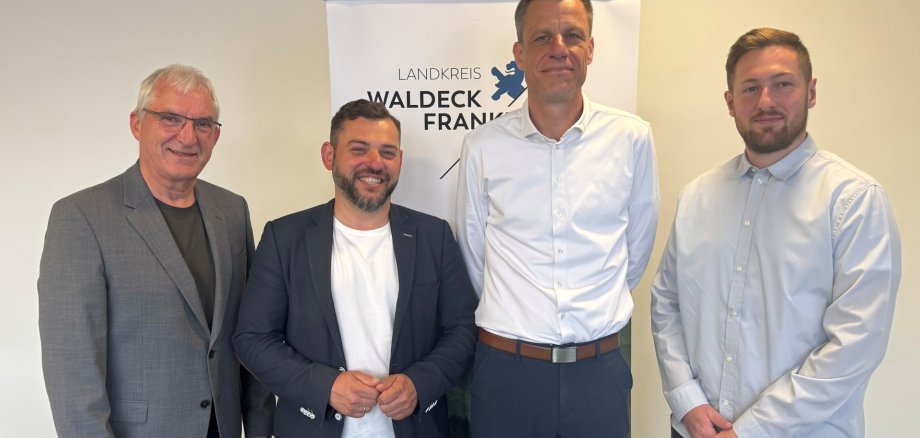
Caption: First Deputy District Administrator Karl-Friedrich Frese and business development officer Dimitrij Schmalz, together with Tim Bernhardt and Sebastian Jilg from the consultancy firm Infratech Services, are setting out to drive forward the roll-out of high-speed internet in Waldeck-Frankenberg (from left to right) (Photo: Waldeck-Frankenberg District)