

Pilot project: Artificial intelligence to ease the workload in social services
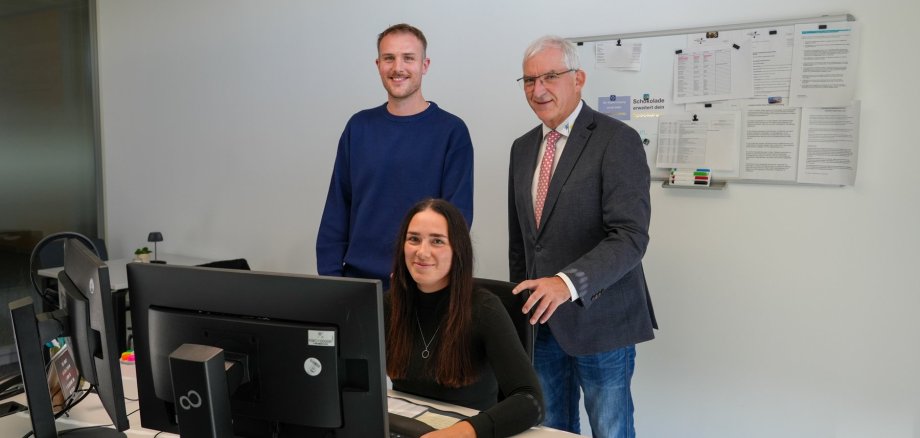
Caption: First Deputy District Administrator Karl-Friedrich Frese (right) and Christopher Emde (Specialist Service for District Bodies, Organisation, Procurement and Public Transport) present the pilot project on the use of artificial intelligence in the Youth Services Department, which is currently being trialled by Tiana de Matos Martins and her colleagues in Social Services.
The district of Waldeck-Frankenberg is one of 38 selected local authorities across Germany taking part in the second phase of the ‘Agentic AI Hub’ innovation programme run by the Federal Ministry for Digital and State Modernisation. A three-month pilot project is now underway to test the use of a specialised AI solution to support case documentation within the youth services department of the social services division. The main aim of the trial is to determine whether and how the technology can relieve staff of time-consuming, repetitive documentation tasks, thereby potentially freeing up more time for the direct support of citizens.
The pilot project began on 16 September 2026 and will run until 15 December 2026. The Waldeck-Frankenberg district is working closely with the start-up Sozial KI UG on this project.
An opportunity for a modern and citizen-centred administration
The ‘Agentic AI Hub’ is a federal funding programme specifically designed to strengthen collaboration between start-ups and the public sector in order to test the practical application of AI. The Waldeck-Frankenberg district is seizing this opportunity to actively seek solutions to the challenges facing the social sector. The costs incurred during the trial phase are borne by the Federal Ministry. The district administration would only need to invest funds once AI has been established on a long-term basis following the project.
First Deputy District Administrator Karl-Friedrich Frese explains the strategic objective of the trial: “We face major challenges in the social sector. The tasks are becoming more complex, whilst at the same time we are feeling the effects of the shortage of skilled staff. That is why we must explore new avenues. With this pilot project, we want to explore whether modern technologies such as AI can help relieve our highly qualified staff of routine tasks. Our aim is not to replace people, but to provide them with a tool so that they have more time for what really matters: offering personalised advice and support to the people of the Waldeck-Frankenberg district.”
Christopher Emde from the specialist department for district authorities, organisation, procurement and public transport adds from a practical perspective: “Part of the day-to-day work in our specialist departments involves meticulous documentation. This is important, but it also takes up a lot of time. We are keen to see whether the AI solution can genuinely help the Youth Department in its day-to-day work to record the relevant information more quickly. Every minute not spent on pure administration is a minute gained for direct dialogue with citizens who need support.” It is important to note that the AI operates according to the ‘human-in-the-loop’ principle. It is intended to serve as an intelligent assistant, but the final review, assessment and decision always remain the responsibility of the human case worker.
Objectives and research questions of the‘
’testDuring the three-month pilot phase, the study will examine whether the use of AI leads to a measurable reduction in processing time and whether staff perceive the technology as providing genuine support in their day-to-day work. The focus is also on the technical accuracy of the AI support and its practical suitability – in other words, whether the solution can be integrated effectively into existing workflows. At the end of the pilot phase, the results will be comprehensively evaluated. This evaluation will provide a data-driven basis for deciding whether the long-term use of the solution is advisable.